How myVP, Chief of Staff, keeps the whole picture in view. All the time.

Configured context is a snapshot of the day you set it up. Your business keeps moving. myVP's context moves with it.
What makes you good at what you do?
It's that every time you decide, you decide while holding everything that bears on the call, right at the moment you make it.
Someone asks whether to approve the Dupont quote. You don't just answer yes or no on the quote. You answer knowing Dupont has already pushed twice, that cash is tight until the 15th, and that your partner has a view on this you'll have to manage. For you, that happens without effort. It's just there.
That's the skill. Not knowing more than anyone else — holding the whole picture while you decide.
And that's exactly what a standard AI assistant doesn't have.
Yes, you can give your AI context but...
When you set up an AI assistant, you can hand it your documents and write your instructions: how you work, who your clients are, what matters. It works. It genuinely works — the answers get noticeably better.
But look at what you actually did. You chose what went in. On the day you set it up. Based on what was on your mind that day.
You gave it a photograph. But your business is a film.
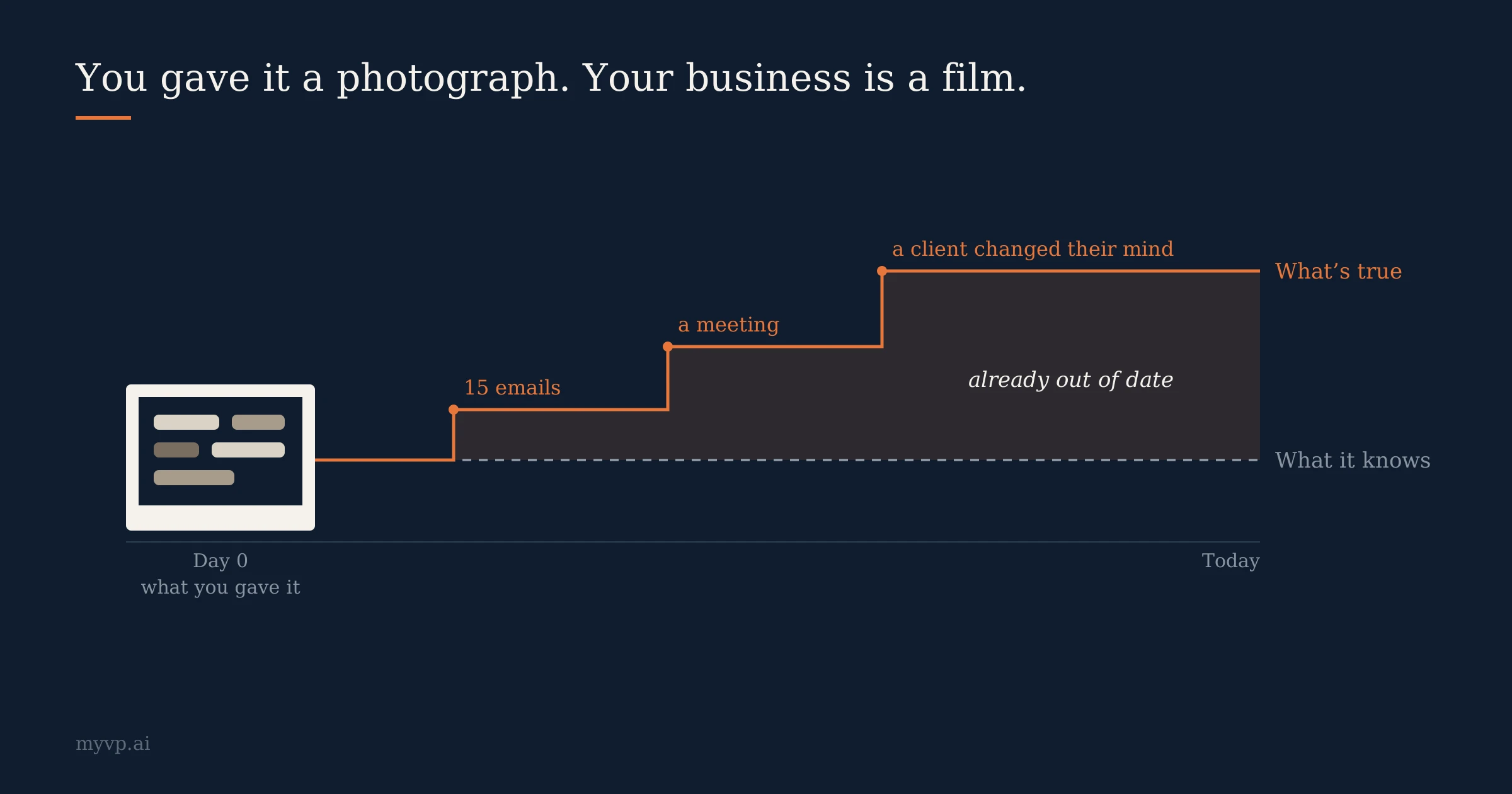
By the next morning there were fifteen emails, a meeting, a client who changed their mind about something. None of that is in there. Not unless you go put it there — and you don't, because you have a business to run.
The context you gave your assistant is already out of date.
The context of an AI is often less reliable than it appears
And this is where it becomes a real problem.
Stale context means an answer that's off — and reads like a good one.
Here's what separates this from an ordinary flaw: the answer won't tell you it was missing something it needed to be right. It arrives clean. Well written. Confident. Built on last week. There's no error message for I was working from a partial picture.
A system that only sees what you handed it has no idea what it wasn't handed. So it answers with what it has, in the same assured tone it would have used with everything.
A wrong answer, you catch. This isn't a wrong answer. It's a plausible one, missing the thing that would have changed your mind.
Your business doesn't keep its truth in files
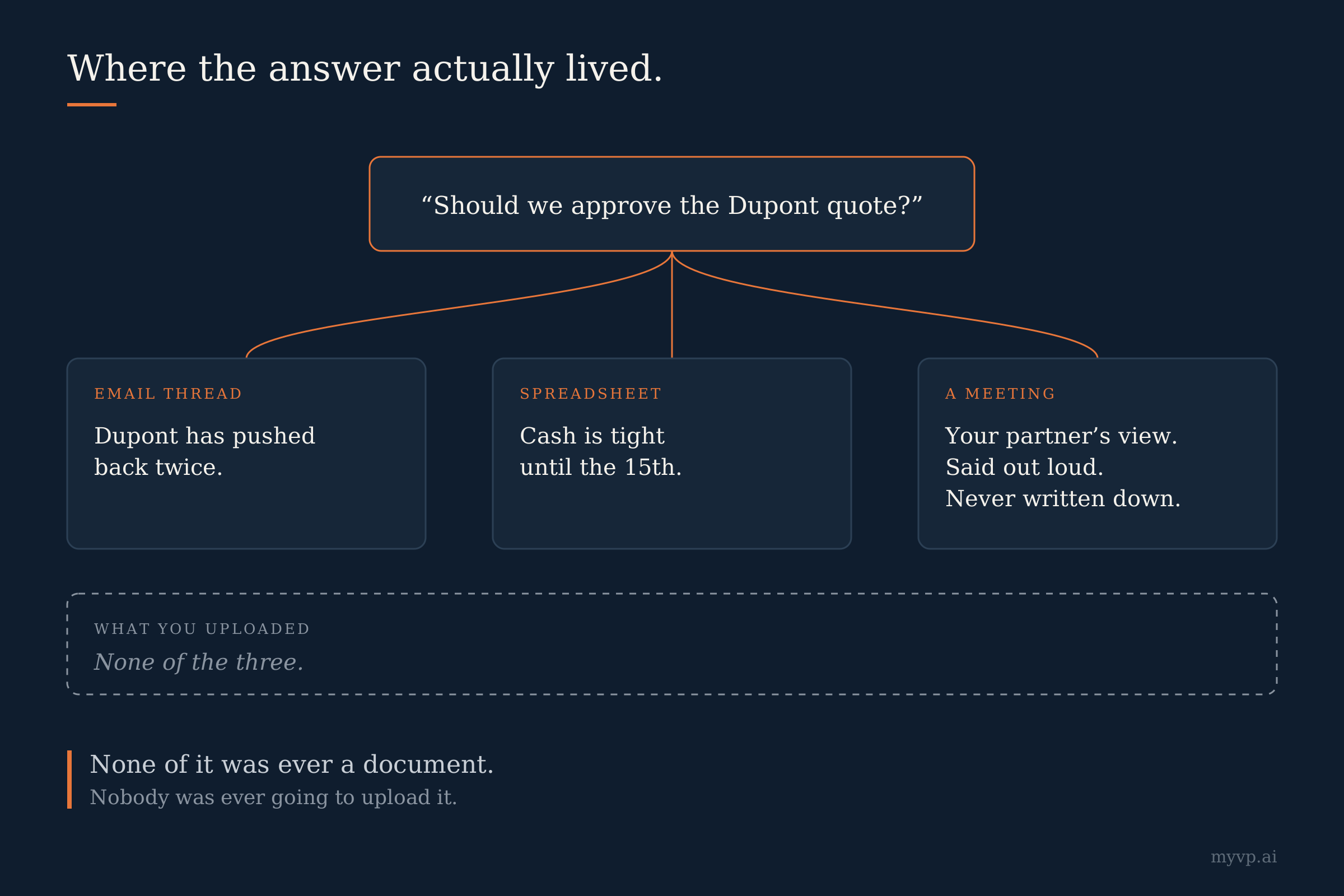
Go back to the Dupont question, and look at where each piece actually lived.
The two delays were in an email thread. The cash position was in a spreadsheet. Your partner's view was said out loud, in a meeting, and never written down anywhere.
None of that was ever a document. Nobody was ever going to go upload it.
This is the thing everyone misses in conversations about "giving your data to AI." The instinct is to think files — the folder, the export, the report. But an organization doesn't keep its truth in files. It keeps it in threads, in calendar slots, in CRM records, and in what got said in a room on a Tuesday afternoon.
Here's what that costs, concretely.
Say you have an AI handling your client messages. You gave it your rates, your services, your hours — a clean document, properly maintained.
A client writes in: "can I get the same price as last time?" The reply goes out, flawless. Polite, professional, at the standard rate.
Except last time, you gave that client a break on price. It's in your orders. It was never in the document.
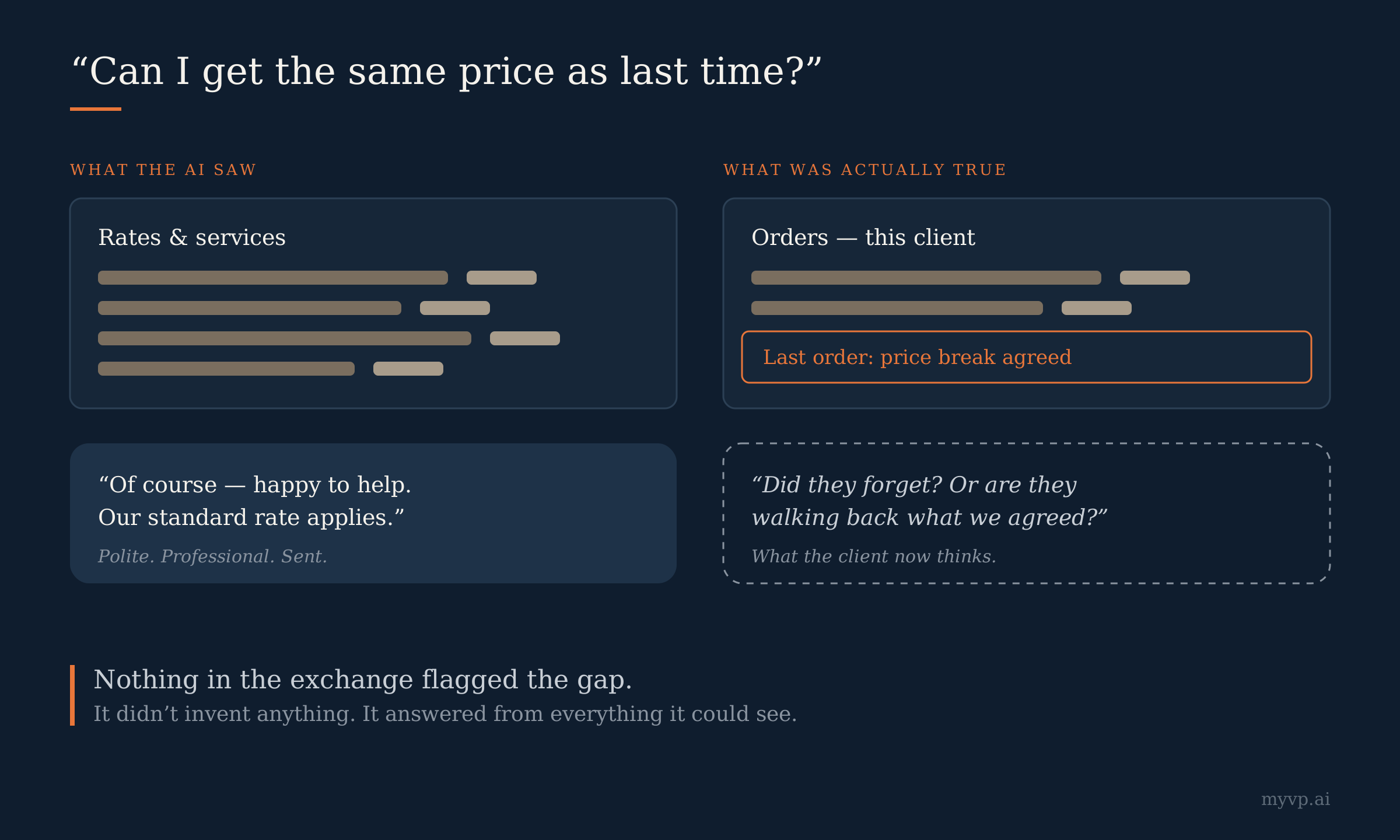
Now your client thinks you forgot — or worse, that you're quietly walking back what was agreed.
That isn't an AI error. The system didn't invent anything. It answered correctly from everything it could see. The problem is what it couldn't see, and the fact that nothing in the exchange flagged the gap.
Context you feed, or context that accumulates
So the real question was never whether your AI has context. Today, nearly all of them can. The question is whether that context is something you have to feed, or something that builds itself.
Context you feed has an expiration date. It reflects the day you put it together and starts drifting immediately. It also asks something impossible of you: guessing in advance what will turn out to matter. But you only find out what matters when the question lands. You can't prepare context for a question you haven't been asked yet.
Context that accumulates works the other way around. It sits on what's already moving — the email threads, the calendar, the open files, the CRM, what got captured from yesterday's meeting — and it grows without you doing anything about it.
That's the design decision behind myVP.
Nothing to update. Nothing to re-upload. The context doesn't get rebuilt at the start of every conversation, and it isn't a snapshot of what you thought was important last month. It carries.
So when you ask about Dupont, the answer comes back with everything around it. The delays, pulled from the email thread. The cash constraint. The commitment that's been open since March.
Including the part you'd forgotten.
The right context at the right time
There's a version of AI assistance that makes you faster at tasks. Draft this, summarize that, make this sound more formal. It's useful, and it genuinely saves time.
And there's another kind, the kind that helps you think and decide — which takes something else entirely. Not a better writer. A system that knows the situation around the question, the way a good chief of staff does after eighteen months at your side. That isn't a question of model quality. It's a question of what the system is plugged into, and whether the context it holds is the one you're actually operating in, right now.
myVP is an AI Chief of Staff for business leaders — one interlocutor across email, calendar, documents, CRM, projects and meetings, with a memory that accumulates instead of starting over.
See how it works → Next in this series: it keeps your fronts apart — and knows when they touch.