I use Claude every day. It’ll never be my Chief of Staff.

"Why build myVP if you use Claude every day?" It's the question I get most — and it treats two different categories as versions of the same product. What these tools genuinely do well now, and the five structural gaps no update will fix.
I'll start with something that might sound strange coming from someone building a product in this space: I use Claude every day. It's one of the most powerful tools I've come across in my working life.
But I get the same question almost every week, from smart, well-informed executives:
"If you use Claude — or ChatGPT — that much, why did you build myVP? Couldn't you just use Claude as your Chief of staff?"
It's a great question, and it's exactly the wrong one. Not because the answer is obvious, but because it treats ChatGPT or Claude and an AI Chief of Staff as two versions of the same product. They aren't.
Driving a truck, or running the fleet
Here's my position, straight out: ChatGPT and Claude will never be your AI Chief of Staff.
Not because they aren't good enough. Because it isn't the same category of product — or the same kind of relationship.
I was talking with myVP one day about an angle for an AI training program aimed at executives, and got an analogy back that stuck with me:
"Knowing how to drive tells you nothing about your ability to run a logistics company."
That's exactly the relationship between using ChatGPT and having an AI Chief of Staff.
Knowing how to use ChatGPT is knowing how to drive. You turn the wheel, you hit the gas, you get where you're going. It's useful, it's powerful, and plenty of people have stopped there — rightly, for the uses that fit.
Having an AI Chief of Staff means running the fleet, the drivers, the routes, the clients, the contracts, the breakdowns you need to see coming — from inside your own car, while you're driving it.
The difference isn't in the engine. It's in how many things you're keeping running at once.
What ChatGPT and Claude do exceptionally well
Before going further, let me be clear: I'm not writing this to knock these products. I'm writing to clear up a category confusion.
What they do exceptionally well:
→ Answer a complex question in seconds, with a precision that used to take hours of research.
→ Analyze a dataset, an export, a dashboard — spot a trend, an anomaly, what's missing.
→ Structure a line of reasoning: break down a decision, lay out the options and their trade-offs, stress-test an argument.
→ Build a model, test assumptions, compare scenarios with real numbers.
→ Summarize long documents, produce content, debug code, translate with nuance.
→ Automate and execute tasks. With one important distinction I want to dwell on.
Automating isn't orchestrating
People conflate automating and orchestrating. They aren't the same thing.
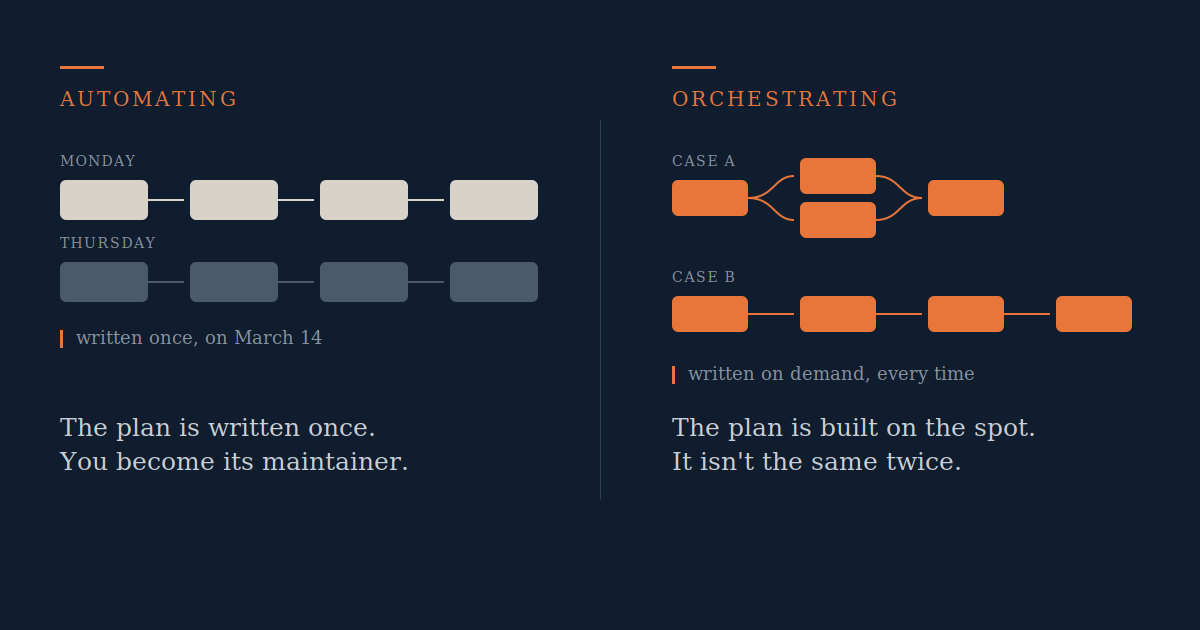
Automating means defining a sequence ahead of time and replaying it. You decide: when this happens, do that, then that. The system runs your plan.
Orchestrating means deciding on the sequence at the moment the need shows up, based on the actual context. Nobody wrote the plan in advance. The system builds it, and it isn't the same plan on Tuesday as on Thursday — or in case A as in case B.
One clarification is in order here, because the landscape has moved: AI-driven automations aren't rigid scripts anymore. They adapt, they handle variants, they catch cases that weren't spelled out word for word. That's real, and it's real progress.
But the question isn't flexibility of execution. It's who owns the plan, and who owns maintaining it.
Every automation you set up is a contract you sign with your future self. It saves you fifteen minutes a day and costs you two hours on a Tuesday night, when you have to work out why it stopped producing the right result.
At the scale of an executive running several ventures, you haven't built a system: you've become the maintainer. You've taken on one more role.
I use them for all of this. Every day. I have no interest in claiming they're bad — they aren't. They're among the most impressive tools available today.
But none of that makes one a Chief of Staff.
A horizontal product isn't a vertical role
AI Chief of staff — you might be thinking: sure, but why not just use ChatGPT or Claude? Why build something specific?
Let me be honest here, because the easy answer would be to say these products know nothing about your business, have no memory, never act on their own. That was true two years ago. It isn't anymore, and claiming otherwise would cost me more credibility than it would ever buy me.
Today, ChatGPT and Claude have memory that carries from one session to the next. Workspaces you configure. Connectors into Gmail, calendar, Drive, Slack, CRMs. Agents that run on a schedule or on an event, in the background, without your computer even being on. They live in your Slack.
So the debate over whether a model alone is enough — whether you need a system around it — is settled. The best AI labs in the world are building that system themselves. You don't have to take my word for it.
The difference isn't there. It comes down to one thing: who the system is built for.
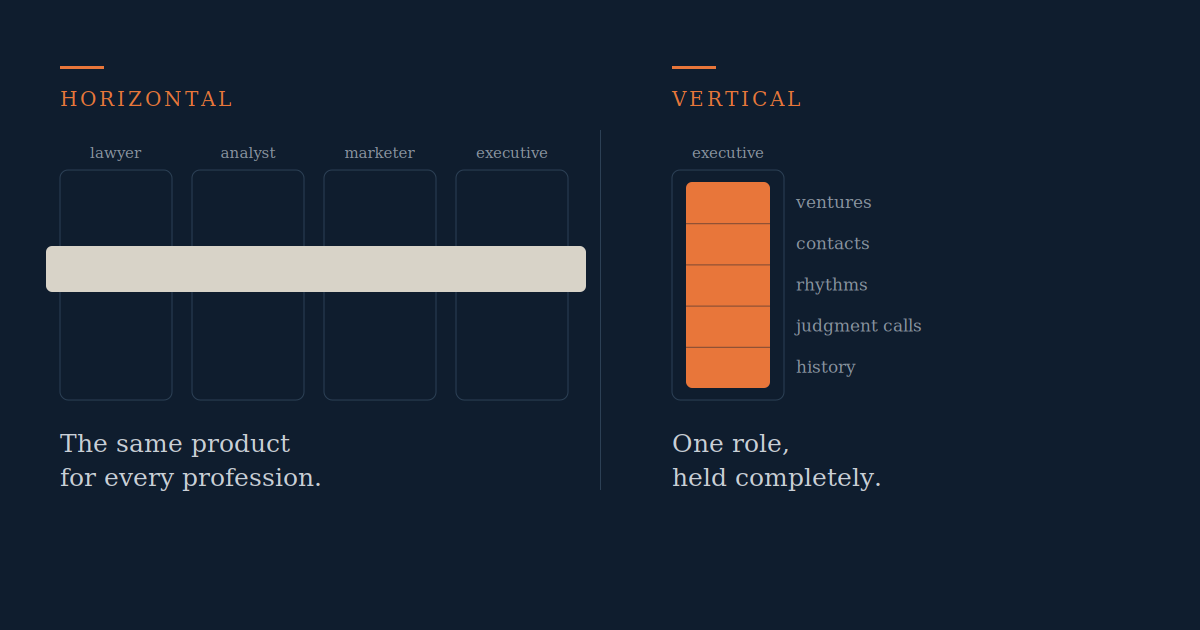
They're building the horizontal system. An excellent executor, generic, for every knowledge profession. A lawyer, an analyst, a marketer, an executive — the same product for everyone. It's a coherent choice, and it's what lets them serve as many people as they do.
I'm building the vertical one. Configured for one particular executive: their ventures, their contacts, their rhythms, the way they make calls. One role, but held completely.
And there's a phrase that draws the line, in their own words: you hand it the work. That's exactly it. You hand it a job. You're still the one deciding which job, when, and with what context.
Which means the role is still yours to hold. A Chief of Staff holds it with you.
Five gaps a horizontal product won't close
Not feature gaps. Structural gaps. Things no update is going to fix — because that isn't where the problem is.
1. Context: two briefings, the same question
Rather than explain it, let me show you.
Tuesday, 7:40 a.m. You ask both the same thing: "What do I need to keep in mind today?"
What a general-purpose AI assistant says, connected to your calendar and inbox:
Good morning! Here's your day:
- 10:00 — Team check-in (1h)
- 2:00 — Meeting with Marc Delaunay (45 min)
- 4:30 — Call with Clara Vasseur (30 min)
You have 12 unread emails, 3 of them received after 6 p.m. yesterday. A couple of suggestions: prep for your 2:00 ahead of time, and block a deep work window late morning if your calendar allows. Have a great day!
--
It's accurate. It's well written. And it's completely useless — because you already knew all of it. It read your calendar back to you out loud.
What myVP says:
Morning. Three things, in order.
The real subject today is the 2:00 with Marc — but not for the reason on the calendar. The meeting is booked as a renewal conversation, except he wrote you Friday night mentioning their internal reorg. The actual question is whether the decision path is still the right one. I've pulled the last three exchanges and a recap of what was promised in March.
One commitment has been sitting for 12 days. You told the agency team you'd decide on moving to two sections before the end of the month. Four business days left and nothing's moved. It isn't urgent today. It becomes urgent Thursday.
And a note on Clara: you pushed that follow-up deliberately, to line it up with the announcement of the new format — the idea being to show up with a credibility signal rather than a transactional check-in. The announcement went out ten days ago. The reason for the delay is gone. The 4:30 call is the right moment.
The 10:00 brainstorm, honestly, can go. You've already moved it twice this month and the agenda is empty. Look at what actually separates those two answers.
The first read your calendar. The second read your situation. It knows your ventures run in parallel, the history behind each contact, what you agreed with whom and how long ago, and above all: why you made certain calls. It isn't returning data. It's exercising judgment about what deserves your attention today.
This isn't a memory question.
A horizontal product can absolutely retain what you told it. The difference is elsewhere: what it holds is what you took the time to give it, on the day you gave it.
An AI Chief of Staff knows your business before the conversation starts — because it's plugged into what's moving, continuously, without you feeding it anything.
2. Real meaning needs the whole picture
This is the most misunderstood one, and it isn't about memory.
Nothing stops a general-purpose assistant from retaining the reasoning behind a decision. You write it down, it keeps it. Technically, that's solved.
The problem is that a reason stays valid until something contradicts or cancels it — and that something usually happens somewhere else, in another system, in a place your assistant isn't watching.
Go back to Clara. The reason for the delay — waiting for the new format announcement — is perfectly memorable. It can live in a dedicated workspace, written down in black and white. But the announcement went out ten days ago, and that fact lives in your email, in a published post, in a conversation in a meeting. It isn't in the space where your reasoning is stored.
Nothing brings the two together. So your assistant never tells you the reason no longer exists.
That isn't a memory failure. It's a scope failure.
Reasoning kept in an isolated space can't be checked against the world it described. It stays true inside its jar, and false outside it.
It's structural: partitioning protects the context and simultaneously cuts off access to whatever would keep it alive. The only way out is a system that holds the reasoning and the live flow inside the same perimeter.
Not remembering better. Seeing wider.
3. Several ventures at once: what a general-purpose assistant can't hold
This one gets discussed least, and for a lot of the executives I meet, it's the one that hurts most. You aren't running one thing. You're running three, four, sometimes more: a main company, something on the side, a project getting off the ground, an outside board seat. Each has its own contacts, deadlines, vocabulary, priorities — and above all, its own decision logic.
With a horizontal product you have two options, and both are bad.
Either you mix everything into one thread, and it answers you with contaminated context — venture A's priorities applied to venture B's judgment calls.
Or you partition into separate spaces, and you lose exactly what matters: the view across. Nobody tells you the week of the 14th is jammed because three of your ventures each booked something important into it without seeing each other.
A real AI Chief of Staff holds both at once. Each venture keeps its own context, its own history, its own contacts, its own language. And above all of it, one reading of your actual load, across every perimeter.
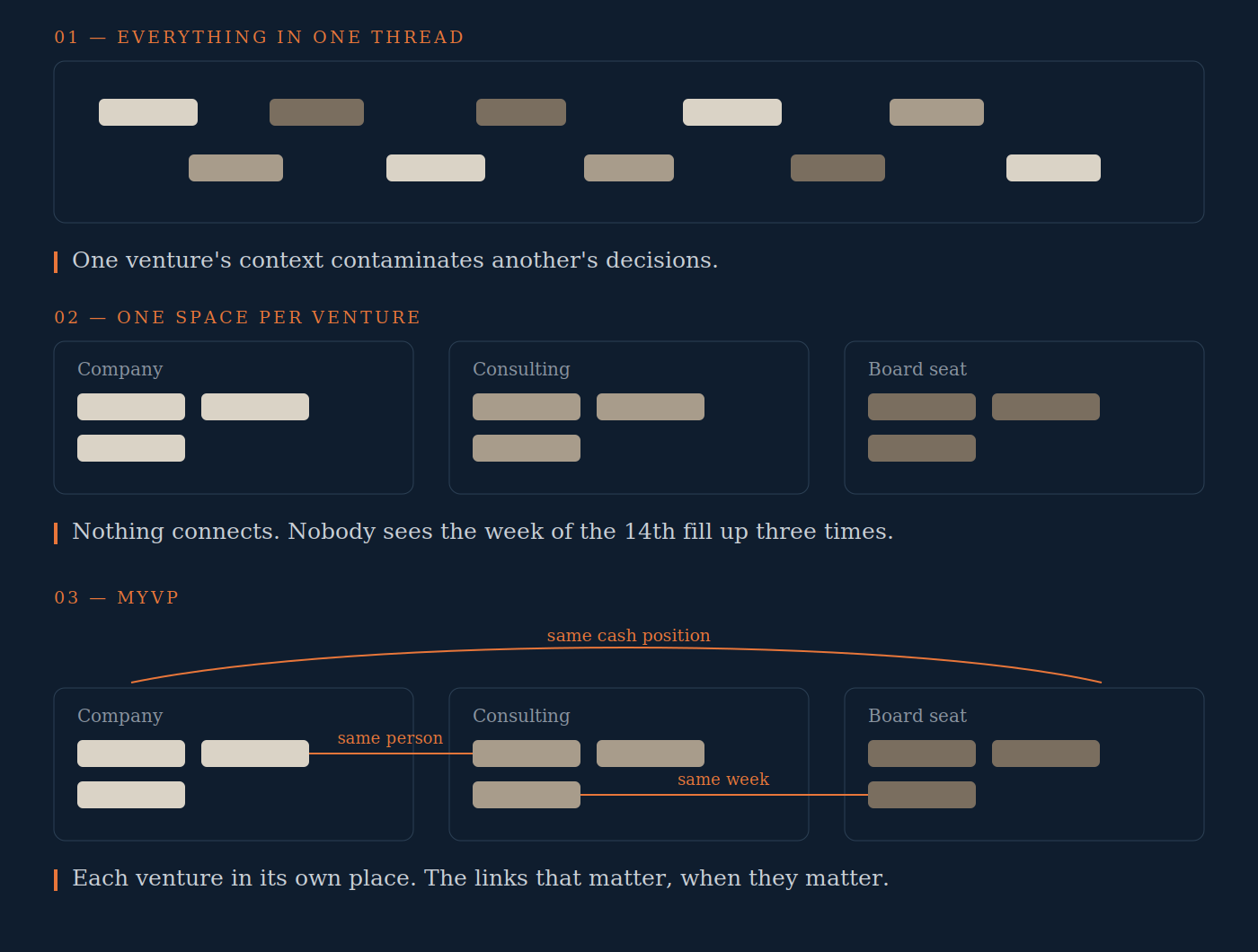
A product designed for a user who does one thing doesn't become multi-venture by adding a dropdown.
4. Real proactivity, not scheduled reactivity
You can schedule a task now: "every Monday at 6, prep my client briefing." You can even trigger it on an event: a message landing in a channel, a file dropped somewhere. The system runs in the background and you find the result when you wake up. That's real, it's well built, and it's real progress.
But triggered isn't proactive.
Schedule or event, you wrote the trigger. Once, when you set it up. The system replays your past intent against a condition you defined. It decides nothing. It notices nothing you didn't point it at.
Real proactivity is the system raising what you never asked it to watch:
→ A commitment aging, when you never created a reminder for it. → A contact going cold, with nothing visible having happened. → A conflict forming between two of your ventures in the same week. → On Monday, what you promised on Friday — with nobody having written it down.
None of those four has a writable trigger. There is no event called this relationship is cooling off. It takes a persistent model of your business, and continuous judgment about what deserves to reach your level.
A system that executes jobs decides how to do them. A Chief of Staff decides which jobs exist.
And that attention is only worth something if it can reach you — where you already are: Slack, Telegram, the web app, by text or by voice. Without one more app to open. That's true on both sides now: general-purpose assistants live in Slack too.
The question isn't the channel anymore. It's who decides there's something worth saying.
5. One request, several systems in motion
You can connect an assistant to Gmail, Drive, calendar, your CRM. It'll do what you tell it to do.
But you're the one configuring, you're the one arbitrating, you're the one deciding who does what when.
An AI Chief of Staff does.
When I tell it:
"Block the slot, summarize the latest announcements, add the links as a calendar note, save this contact and draft the follow-up"
— it updates the calendar, runs the research, saves the contact to the CRM, writes the email. One instruction on your side. Several systems in motion on the other. And a report at the end.
That report deserves a mention, because it's the detail nobody puts forward: it also tells you what didn't get done. Contact saved, but the slot couldn't be blocked because the room wasn't free.
It isn't spectacular, and it's decisive.
A system that hands you a flawless report while staying silent about what failed teaches you to double-check everything — and a Chief of Staff you double-check isn't one. You only delegate long-term to someone whose report you believe.
Claude and GPT are inside myVP
Here's the part that might surprise you, and it closes the loop.
myVP is built on AI models like Anthropic's Claude and OpenAI's GPT, and on others, depending on the use.
That isn't a contradiction. It's exactly the distinction I've been drawing.
A language model, however excellent, isn't a product. It's a component. Claude is a remarkable component — maybe the best available today for this kind of work.
But an AI Chief of Staff is what you get when you wrap a component like that in a system designed for your specific business: its access channels, its context preloaded and kept current, its continuous attention, its orchestration across your tools, its natural working language, its morning briefing and its end-of-week wrap, its honesty when it hits a limit.
To go back to the road we started on: the engine isn't the car. And the car isn't yet the logistics company.
So when do you use which?
Fair question. Here's my answer, based on daily practice.
The rule comes down to one question: does everything needed to answer fit inside what you just typed? If it does, a horizontal product will do the job beautifully — often better, and for a lot less money.
Use ChatGPT or Claude when:
- You're exploring a subject, a tool, a concept you don't know yet
- You have a document, an export, a dataset in hand and you want to understand it
- You want to stress-test a line of reasoning, lay out the options on a decision, test an assumption
- You're producing something bounded: content, code, an internal app
- You know how to frame the request, and you'll know how to judge the result
Use myVP when:
→ This morning's question depends on what was said three weeks ago, and you're not about to re-explain it
→ You're running three things at once and no tool sees all three
→ What you need to know sits across your email, your calendar and your CRM
→ You decided something for a specific reason, and that reason can stop being true without anyone telling you
→ A request that's simple to say requires putting three systems in motion
The two aren't competitors. The first is a horizontal product, remarkable inside its perimeter. The second is a role held. The first, you call on. The second lives alongside you.
Use, or hire
When people ask why I'm building myVP when I use Claude every day, my answer comes down to one line:
ChatGPT, you use. myVP, you hire.
The difference is in the verb.
Using is what you do with a tool: you open it, you use it, you close it.
Hiring is what you do with a team member: you bring them on board, teach them the business, and trust them to carry critical work while you lead. It’s about the relationship and the day-to-day experience, as I describe in this article looking back on several months of living with myVP.